Coast to Coast. Dock to Dock.
IBC Tote Transportation & Logistics
Whether you are buying totes from us, selling totes to us, or need containers moved between your own facilities, our logistics team handles it. We operate our own fleet supplemented by a vetted network of freight partners to provide reliable, cost-effective IBC tote transportation across all 48 contiguous states. From a single pallet position to 56-tote full truckloads, we move IBC containers every day and know how to do it efficiently.
Fleet & Capabilities
Our transportation infrastructure is built specifically around the unique requirements of moving IBC containers. These are not small packages — they are 48-inch cubes that weigh 125-160 lbs empty and up to 2,400 lbs full. Moving them safely and efficiently requires the right equipment and experience.
Our Own Fleet
We operate a dedicated fleet of trucks out of our Charlotte, NC hub. This includes 53-foot dry vans for full truckload IBC shipments, 26-foot box trucks for regional deliveries of smaller quantities, and flatbed trucks for oversized loads or totes that need to be loaded from the side. All vehicles are equipped with air-ride suspension to minimize damage during transit and carry the strapping and load bars needed to secure IBC totes properly.
Freight Partner Network
For destinations beyond our direct fleet's efficient range, we work with a network of vetted LTL and FTL carriers who are experienced in handling IBCs. Every partner in our network has been qualified based on their damage rates, on-time delivery performance, and ability to handle palletized bulk containers. We manage the carrier relationship end-to-end — you deal with us, not a random freight broker.
Fleet Equipment Specs
53-Foot Dry Van Trailer
26-Foot Box Truck
Flatbed Trailer
Load Options
We offer three primary load configurations to match your volume, budget, and scheduling requirements.
Full Truckload (FTL)
The most cost-effective way to ship IBC totes in volume. A standard 53-foot dry van trailer holds up to 56 empty IBC totes when stacked two-high (28 on the floor, 28 on top). For loaded totes, capacity depends on product weight but typically ranges from 18 to 24 units per trailer due to weight limits.
FTL shipping gives you the lowest per-tote freight cost, a dedicated truck (no stops or cross-docking), and the fastest transit time. Ideal for orders of 40+ empty totes or 18+ loaded totes.
Less Than Truckload (LTL)
For smaller shipments of 1 to 30 totes, LTL is the practical option. Your totes share trailer space with other freight, and you pay based on the number of pallet positions occupied and the total weight. A single IBC tote occupies one standard pallet position on an LTL carrier.
We consolidate outbound LTL shipments to get better rates than you would booking directly. Transit time is typically 3-7 business days depending on distance and carrier routing. Liftgate service available for deliveries without a loading dock.
Flatbed
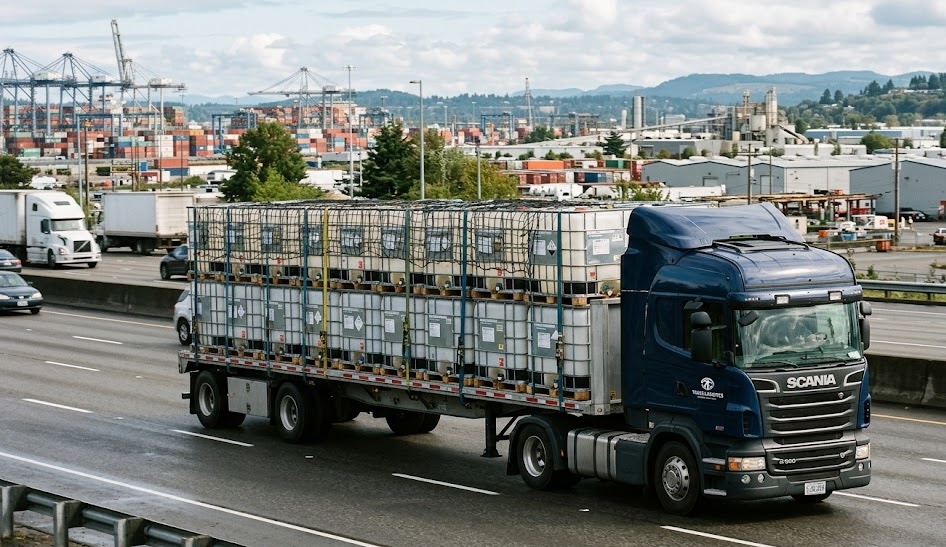
Some situations call for flatbed transport: totes being delivered to locations without a loading dock, oversized or overweight loads, or totes that need to be crane-loaded onto the truck. Flatbed trailers allow side-loading and top-loading access that enclosed trailers cannot provide.
We use flatbeds for construction site deliveries, farm deliveries in rural areas, and any situation where the receiver does not have a standard dock. All flatbed loads are secured with ratchet straps, edge protectors, and tarps when weather protection is needed.
Load Configuration Diagrams
Understanding how IBC totes are configured on different trailer types helps you plan orders for maximum freight efficiency.
53' Dry Van — Empty, Stacked 2-High (56 totes)
53' Dry Van — Loaded/Full Totes (18-24 totes)
26' Box Truck — Empty, Stacked (16-20 totes)
48' Flatbed — Single Layer (28 totes)
Maximize Your Load
Stacking & Palletizing Best Practices
Proper stacking is critical for safe transport and maximizing freight efficiency. Here are the rules our logistics team follows:
Empty Totes: 2-High Max
Standard 275-gallon totes with intact cages stack safely 2-high. The bottom tote cage is designed to support the weight of a loaded tote above it, so two empties are well within tolerance. Never stack 3-high, as cage damage and instability result.
Loaded Totes: No Stacking
Full totes (up to 2,400 lbs each) should never be stacked during transport. The dynamic forces during braking and cornering can cause the top tote to shift, even if cages are rated for static stacking.
Mixed Loads
When shipping a mix of empty and loaded totes, loaded totes go on the floor and empties can be stacked on top if the ceiling clearance permits. This maximizes capacity while keeping heavy weight low.
Securing Methods
Every row of totes is secured with load bars or ratchet straps. Edge protectors prevent strap damage to cage corners. Empty stacked totes are strapped at both levels. We use a minimum of one strap per row for floor-level totes and two straps per row for stacked loads.
Quick Capacity Reference
Regional Transit Times
From our hub at 5809 Long Creek Park Dr, Charlotte, NC 28269 on the I-85 and I-77 corridors.
| Region | FTL Transit | LTL Transit | Key States | Notes |
|---|---|---|---|---|
| Local (< 50 mi) | Same Day | Same Day | Charlotte metro | Direct fleet delivery, free pickup 20+ |
| Southeast | 1-2 days | 2-4 days | NC, SC, VA, GA, TN | Highest route density, best rates |
| South Atlantic | 2-3 days | 3-5 days | FL, AL, MS | Weekly dedicated runs |
| Mid-Atlantic | 2-3 days | 3-5 days | MD, PA, NJ, DE | Strong I-95 corridor coverage |
| Northeast | 3-4 days | 4-6 days | NY, CT, MA, NH, ME | Consolidation reduces LTL costs |
| Midwest | 3-5 days | 5-7 days | OH, IN, IL, MI, WI | Good backhaul rates from I-77/I-70 |
| South Central | 4-5 days | 5-7 days | TX, LA, AR, OK | Regular FTL to Houston/Dallas |
| Mountain West | 5-6 days | 6-8 days | CO, AZ, NM, UT | FTL most cost-effective |
| Pacific Coast | 6-8 days | 7-10 days | CA, OR, WA | FTL recommended for best pricing |
DOT Compliance for IBC Transportation
Standard (Non-Hazmat) Transport
Empty IBC totes and totes containing non-hazardous products are transported under standard DOT freight regulations. Our compliance includes current USDOT operating authority, FMCSA safety registration, driver qualification files for all operators, vehicle maintenance programs with inspection records, and cargo insurance covering the full value of goods in transit. All loads are secured per FMCSA cargo securement rules (49 CFR 393 Subpart I), which mandate specific tie-down methods for cylindrical and rectangular containers.
Hazmat IBC Transport
Totes containing or previously containing hazardous materials fall under DOT hazardous materials regulations (49 CFR 171-180). Our hazmat transport compliance includes CDL drivers with hazmat endorsements and current medical certifications, proper shipping papers with 24/7 emergency contact, vehicle placarding per DOT hazard class requirements, spill containment kits on every hazmat vehicle, hazmat security plans and training documentation, and compliance with special routing requirements for certain hazard classes in specific jurisdictions.
Special Handling for Hazmat Totes
Residue Shipments
IBC totes that are "empty" but contain residue of hazardous materials are still regulated under DOT. We handle the proper classification, packaging, marking, and documentation for these residue shipments. The RCRA empty container standard (40 CFR 261.7) defines when a container is considered empty for waste purposes, but DOT residue rules may still apply for transport.
Incompatible Materials
When transporting hazmat totes, chemical compatibility during co-loading is critical. We never load oxidizers adjacent to flammables, acids next to bases, or reactive materials in shared cargo space. Our dispatchers verify compatibility before assigning loads, and drivers are trained to identify and refuse incompatible load combinations.
Emergency Response
Every hazmat shipment includes ERG (Emergency Response Guidebook) compliance. Shipping papers list the proper shipping name, UN/NA number, hazard class, and 24/7 emergency contact. Drivers carry spill kits rated for the materials being transported and have completed HAZWOPER awareness-level training at minimum.
Manifest Documentation
Hazardous waste manifests accompany all hazmat tote shipments as required by EPA and state regulations. We prepare the manifest, obtain generator signatures, and maintain copies for the full required retention period. The receiving facility signs the manifest upon delivery, completing the chain-of-custody documentation.
Insurance & Liability
Our hazmat transport is backed by MCS-90 endorsement coverage as required by FMCSA for motor carriers transporting hazardous materials. This covers environmental cleanup costs in the event of a spill during transport. Additional pollution liability coverage provides further protection for both us and our customers.
Temperature Considerations
Some hazardous materials have temperature sensitivity during transport. Certain chemicals may become more volatile, reactive, or change viscosity in extreme heat or cold. We monitor weather conditions along transport routes and can schedule shipments to avoid extreme temperatures when the product requires it.
Advanced Logistics
Cross-Docking & Warehousing Options
For businesses that need more than simple point-to-point transportation, we offer advanced logistics services that keep your tote supply chain running smoothly.
Cross-Docking
We partner with cross-dock facilities across the country where inbound tote shipments can be broken down and redistributed to multiple destinations. This is ideal for companies buying large quantities that need to be split across several facilities or regions without routing everything through a single central location.
Short-Term Warehousing
Need totes staged at a regional warehouse before final delivery? We can hold inventory at our Charlotte facility or at partner warehouses in key markets. Totes are stored on our premises for up to 30 days at no additional charge. Extended storage and off-site warehousing are available at competitive rates.
Consolidation Services
If you are buying totes from multiple sources or need to combine purchases with cleaning or reconditioning services, we consolidate everything at our facility and ship as a single load. This reduces freight costs and simplifies your receiving logistics.
Reverse Logistics
For companies that buy totes from us and later sell them back, we manage the complete reverse logistics cycle. Delivery of clean totes to your facility, pickup of empties on a schedule, return to our facility for cleaning or resale, and redelivery of the next batch. A closed-loop tote management program.
Pickup & Delivery Services
For Sellers
Free pickup for 20+ totes. Scheduled within 48 hours. We handle all loading. Work within your preferred time windows.
For Buyers
Freight quoted separately. Same-day local delivery. Tracking on all shipments. Liftgate available for no-dock locations.
Cost Optimization Tips for Shipping
Order in FTL Quantities
The per-tote freight cost drops dramatically when you fill a trailer. A full load of 56 empty totes might cost the same to ship as 20 totes on LTL. If you have storage space, order a full truckload and warehouse the surplus.
Consolidate Regional Orders
If you have multiple facilities in the same region, we can combine orders onto a single truck with multiple stops. The total freight is less than shipping to each location separately.
Time Orders to Our Routes
We run regular routes to high-demand regions. Orders that align with existing route schedules get the best rates because we are already driving that direction. Ask about our current route calendar.
Consider Local Pickup
If you are within reasonable driving distance of Charlotte, NC, picking up totes at our facility eliminates freight costs entirely. Many customers within 200 miles find this worthwhile, especially for smaller orders.
Use Backhaul Opportunities
When we deliver totes to a region and have an empty truck returning, backhaul rates to Charlotte are heavily discounted. If you are selling totes to us from a market we deliver to, ask about backhaul pricing.
Set Up Recurring Shipments
Recurring orders on a predictable schedule let us plan routes more efficiently, which translates to lower freight rates for you. Monthly or quarterly standing orders get preferential pricing on both totes and transportation.
Greener Miles
Environmental Impact of Optimized Routes
We are in the business of sustainability, so it would be contradictory to burn unnecessary fuel moving containers around. Our logistics team actively optimizes every route and load to minimize the carbon footprint of IBC tote transportation.
- ✓Route optimization software minimizes total miles driven per tote delivered
- ✓Backhaul utilization: delivery trucks pick up seller totes on the return trip, eliminating empty-mile runs
- ✓Load consolidation: we batch LTL orders by region to fill trucks before they roll, reducing per-tote emissions
- ✓Maximized stacking: double-stacking empty totes means we move twice as many totes per gallon of diesel
- ✓Regional hub partnerships reduce long-haul trips by staging inventory closer to high-demand markets
- ✓Carbon tracking: we calculate and report the CO2 footprint of every shipment
Logistics by the Numbers
Scheduling & Tracking
Flexible Scheduling
We work with your schedule, not the other way around. Need an early morning delivery before your production shift starts? A weekend pickup so it does not disrupt weekday operations? A specific two-hour delivery window to coordinate with your receiving team? We accommodate it. Our dispatchers confirm appointment times 24 hours in advance and communicate directly with your dock or site contact. For recurring orders, we set standing appointment times that become part of your regular workflow.
Shipment Tracking
Every shipment gets a tracking number. For FTL loads on our own fleet, we provide real-time GPS tracking so you can see exactly where your totes are. For LTL shipments through our carrier partners, we provide the carrier's PRO number and tracking link. You receive automated notifications at key milestones: shipment dispatched, in transit, out for delivery, and delivered. Our team is available to answer any questions about your shipment status.
Transportation FAQ
How much does it cost to ship IBC totes?
Freight costs depend on four factors: distance from our Charlotte hub, number of totes (FTL vs. LTL), whether totes are empty or loaded, and accessorial services needed (liftgate, inside delivery, etc.). FTL shipping for 56 empty totes can cost as little as $1-3 per tote per 100 miles. LTL rates for small quantities are higher per tote but lower total spend. We quote freight as a separate line item so you see exactly what transportation costs before committing. Contact us with your zip code and quantity for a specific freight estimate.
Can you deliver to a location without a loading dock?
Yes. We offer liftgate service on our 26-foot box trucks, which hydraulically lowers totes to ground level. Drivers can then use a pallet jack to move totes within 50 feet of the truck. For locations where even a box truck cannot access, flatbed delivery with forklift service may be an option. We deliver to farms, construction sites, rural properties, and residential locations regularly. Let us know your site conditions and we will recommend the best delivery method.
What happens if totes are damaged during shipping?
We carry cargo insurance on all shipments. If totes arrive with shipping damage (cracked bottles, bent cages from transit), document the damage on the delivery receipt and contact us within 48 hours with photos. We file the freight claim and either replace the damaged totes at no charge or issue a credit. Our damage rate is well below the industry average because we specialize in IBC handling and use proper securing methods, but when incidents occur we resolve them quickly.
Can you ship loaded (full) IBC totes?
Yes, we transport loaded IBC totes containing product. Loaded totes are floor-loaded only (no stacking) due to weight. A 53-foot trailer can carry 18-24 full 275-gallon totes depending on product density, limited by the 44,000 lb payload maximum. For hazardous materials, additional DOT compliance requirements apply and must be arranged in advance. We need to know the product, its weight, and its hazard classification to properly quote and plan loaded tote shipments.
Do you offer temperature-controlled transport?
For products requiring temperature control during transit, we can arrange heated or refrigerated trailer transport through our carrier network. This is common for food ingredients that cannot freeze in winter or chemicals that become unstable in extreme heat. Temperature-controlled transport is quoted separately based on the specific temperature requirements, route distance, and whether the load fills the trailer. We provide temperature monitoring documentation upon request.
How far in advance do I need to schedule a shipment?
For standard FTL and LTL shipments, 3-5 business days of lead time is typical. Local Charlotte-area deliveries and pickups can often be scheduled within 24-48 hours. Rush same-day service is available for emergencies within our local fleet range. For large orders (multiple truckloads) or shipments requiring special equipment (flatbed, temp-controlled, hazmat), 5-10 business days of lead time ensures we can secure the right equipment and routing.
Can you handle multi-stop deliveries?
Yes. Our dispatchers regularly plan multi-stop routes that deliver totes to 2-4 locations on a single trip. This is cost-effective for companies with multiple facilities in the same region. Multi-stop routes are priced based on the total route miles and number of stops, which is typically less than separate shipments to each location. We optimize stop sequences for minimal total drive time and coordinate delivery windows with each receiving location.
What information do I need to provide for a freight quote?
To provide an accurate freight quote, we need: the pickup or delivery zip code, the number of totes, whether totes are empty or loaded (and product weight if loaded), the type of tote (275-gallon or 330-gallon), any special requirements (liftgate, inside delivery, appointment scheduling, hazmat), and your preferred delivery date. With this information, we can typically provide a quote within a few hours during business hours. For recurring shipments, we provide standing rate agreements.
Insurance & Liability Coverage
Cargo Insurance
Every shipment is covered by cargo insurance up to the full declared value of the totes and their contents. In the unlikely event of a total loss during transit, you are made whole. We carry a minimum of $100,000 per-occurrence cargo coverage on our own fleet and require equivalent coverage from our carrier partners.
Auto Liability
Our fleet and all contracted carriers maintain commercial auto liability insurance meeting or exceeding FMCSA minimum requirements. For hazmat shipments, we carry the higher liability limits required under 49 CFR 387 for motor carriers transporting hazardous materials, providing additional protection in the event of a transportation incident.
Environmental Liability
MCS-90 endorsement coverage is maintained for hazmat transport, covering environmental cleanup costs. Additional pollution liability insurance provides coverage beyond MCS-90 minimums. In the event of a spill during transport, cleanup and remediation costs are covered without falling on your company as the generator or consignee.
Seasonal Shipping Considerations
IBC tote transportation is affected by seasonal factors that impact both pricing and scheduling. Planning ahead saves money.
Spring
Peak agricultural demand drives up carrier rates in rural areas. Book FTL shipments to farming regions 7-10 days ahead. Freight rates to Southeast and Midwest increase 10-15% March through May as tote demand surges.
Summer
Hot weather requires consideration for loaded totes containing heat-sensitive products. HDPE softens slightly above 120 F, though structural integrity is maintained. Schedule deliveries for morning hours in extreme heat regions.
Fall
Post-harvest season brings the best freight rates as carrier capacity opens up. October through November is the optimal time for large-volume shipments. Backhaul rates from agricultural regions drop significantly.
Winter
Northern route transit times increase 1-2 days due to weather delays. HDPE becomes more rigid and brittle below 20 F, so avoid dropping empty totes during loading in extreme cold. Heated transport available for freeze-sensitive products.
Common Shipping Mistakes to Avoid
Mistake: Stacking loaded totes
Solution: Full 275-gallon totes weigh up to 2,400 lbs each. Stacking them during transport risks cage collapse, bottle failure, and cargo shifting. Always floor-load full totes with proper securing.
Mistake: Shipping with open valves
Solution: Even "empty" totes contain residual product. An open valve during transit means product dripping onto other freight, the trailer floor, or the roadway. Always close and verify the valve before loading.
Mistake: Ignoring weight limits
Solution: A trailer loaded with 28 full water totes weighs over 67,000 lbs, well over the 44,000 lb payload limit. Know your product density and calculate total load weight before ordering transport.
Mistake: Booking without liftgate when needed
Solution: If your delivery location has no forklift or dock, you need liftgate service. A 125-lb empty tote cannot be hand-carried off a 4-foot trailer deck safely. Add liftgate service when requesting your quote.
Mistake: Not securing side-by-side totes
Solution: IBCs sitting on pallets can shift laterally during turns. Every row must be secured with load bars or straps. Unsecured totes topple, causing cargo damage and potential driver safety hazards.
Mistake: Shipping hazmat without documentation
Solution: Residue totes from hazardous materials require proper shipping papers, placarding, and certified drivers. Shipping undeclared hazmat is a federal violation with severe penalties. Always declare previous hazardous contents.
Need IBC Totes Moved?
Tell us the pickup location, the destination, and the quantity. We will get you a freight quote and schedule the move. It is that simple.
Get a Freight Quote